
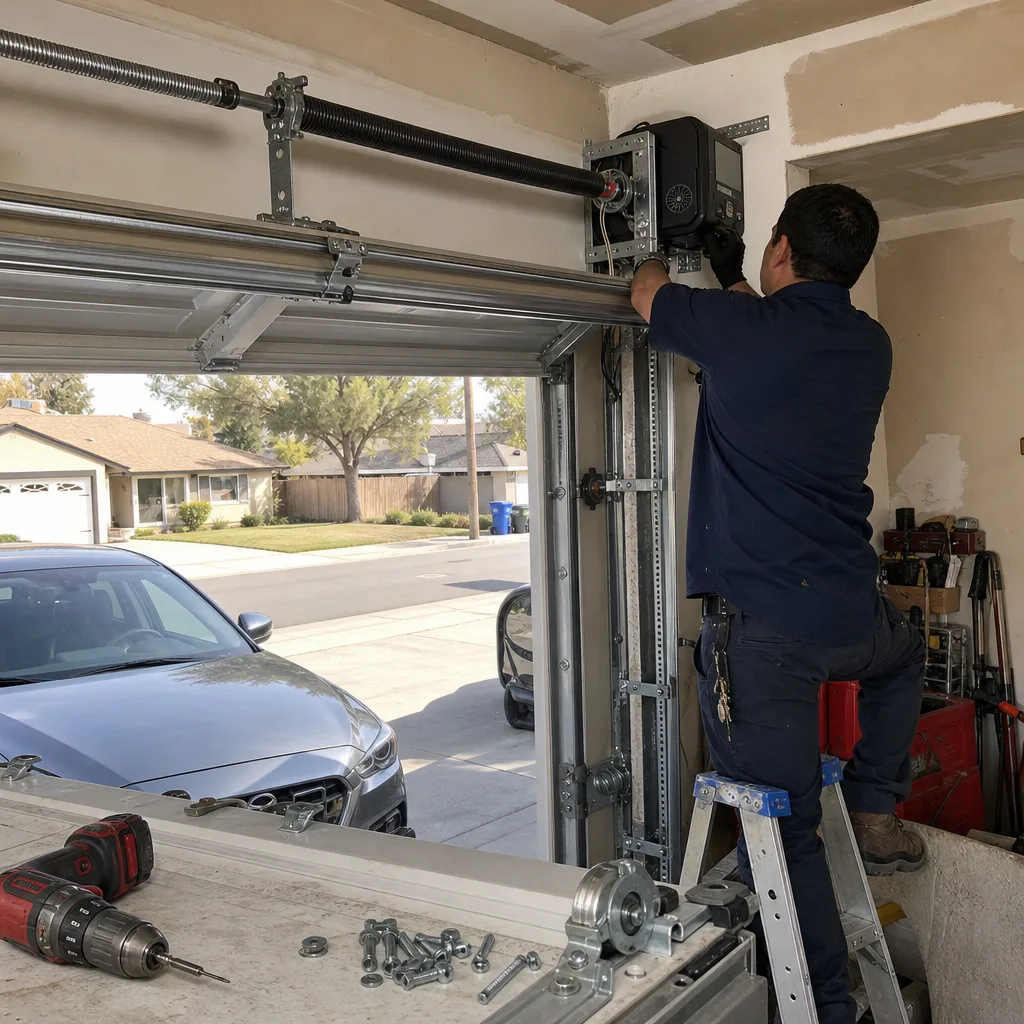
Last updated November 2, 2026
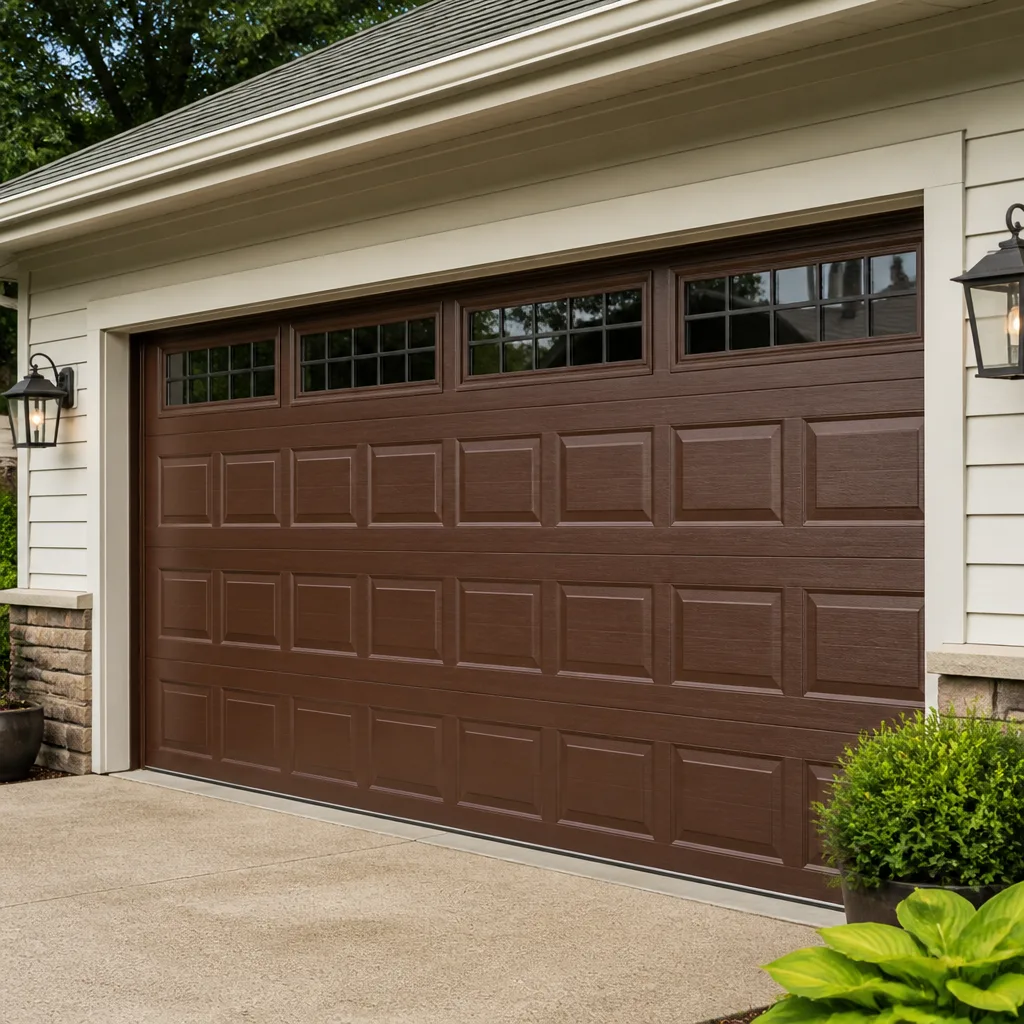 Raised-panel steel
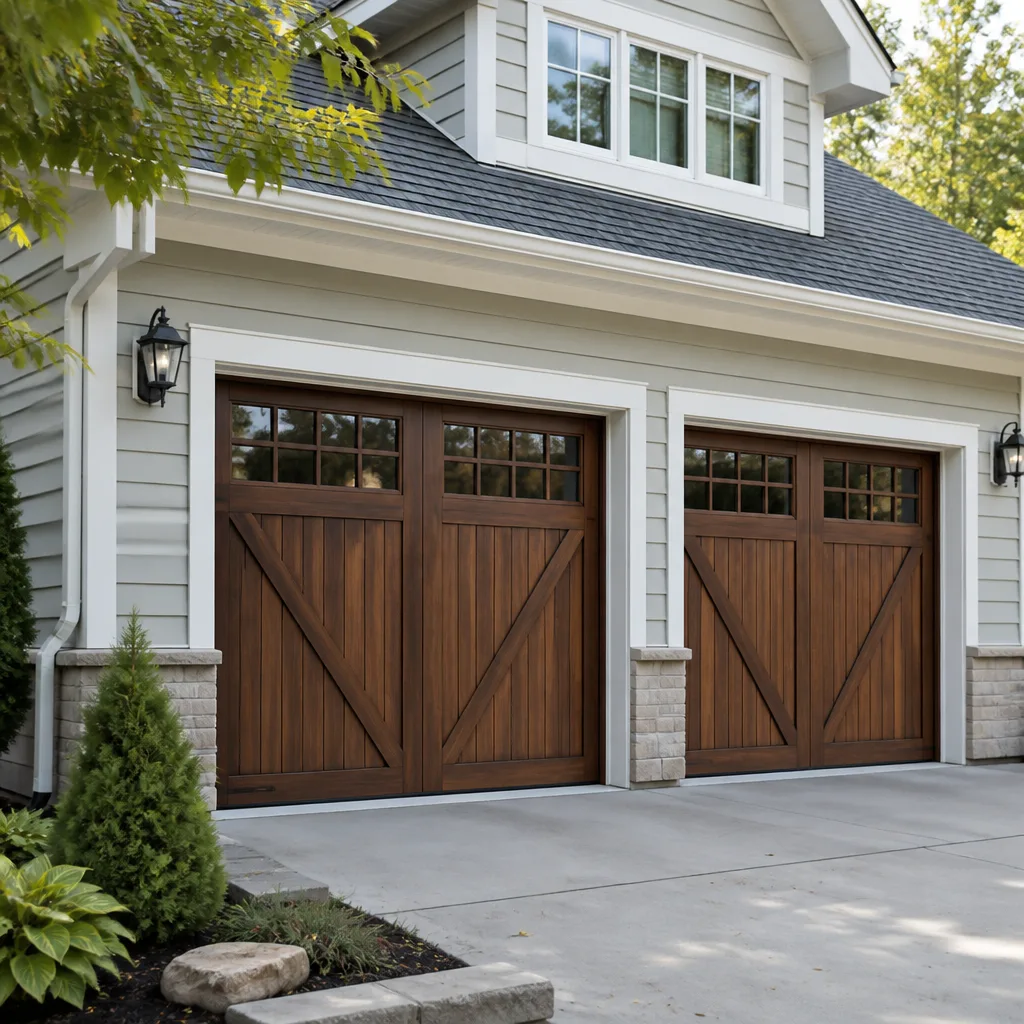 Carriage house
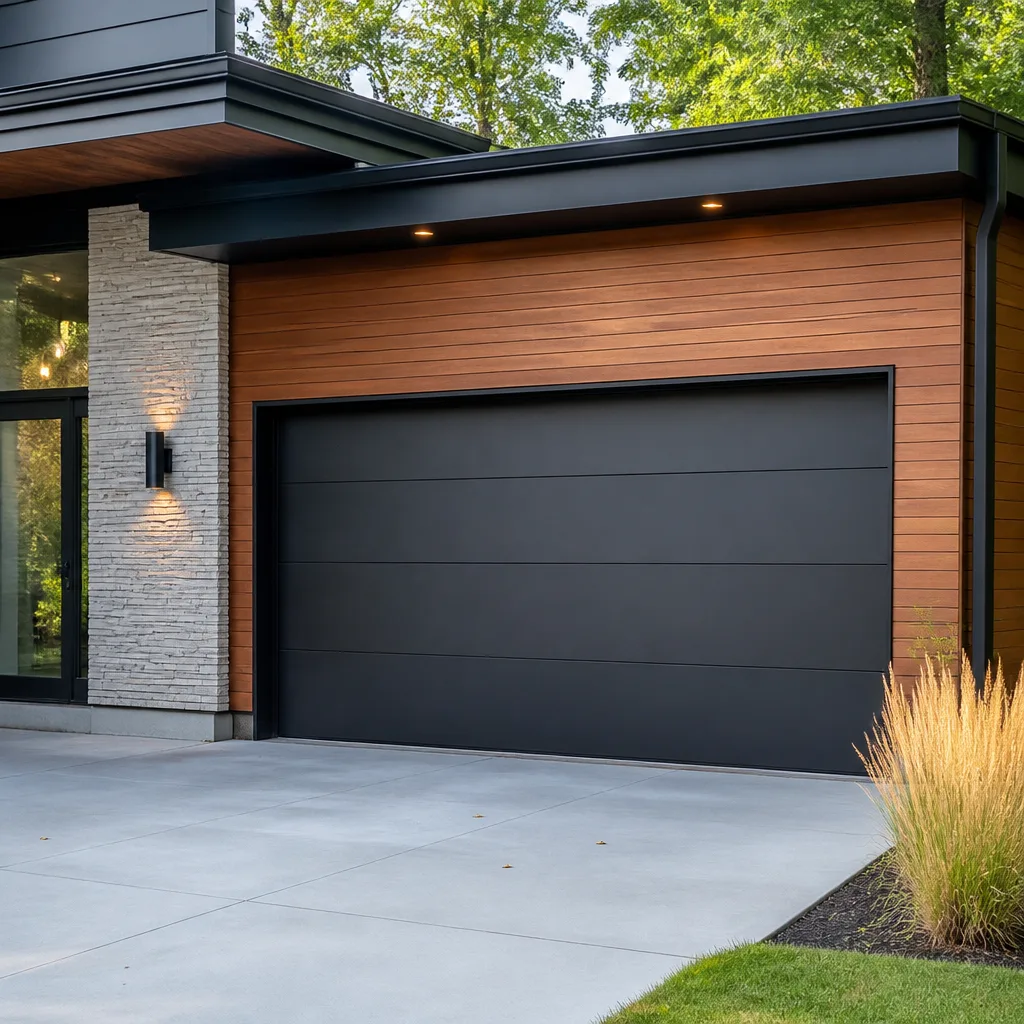 Modern flush
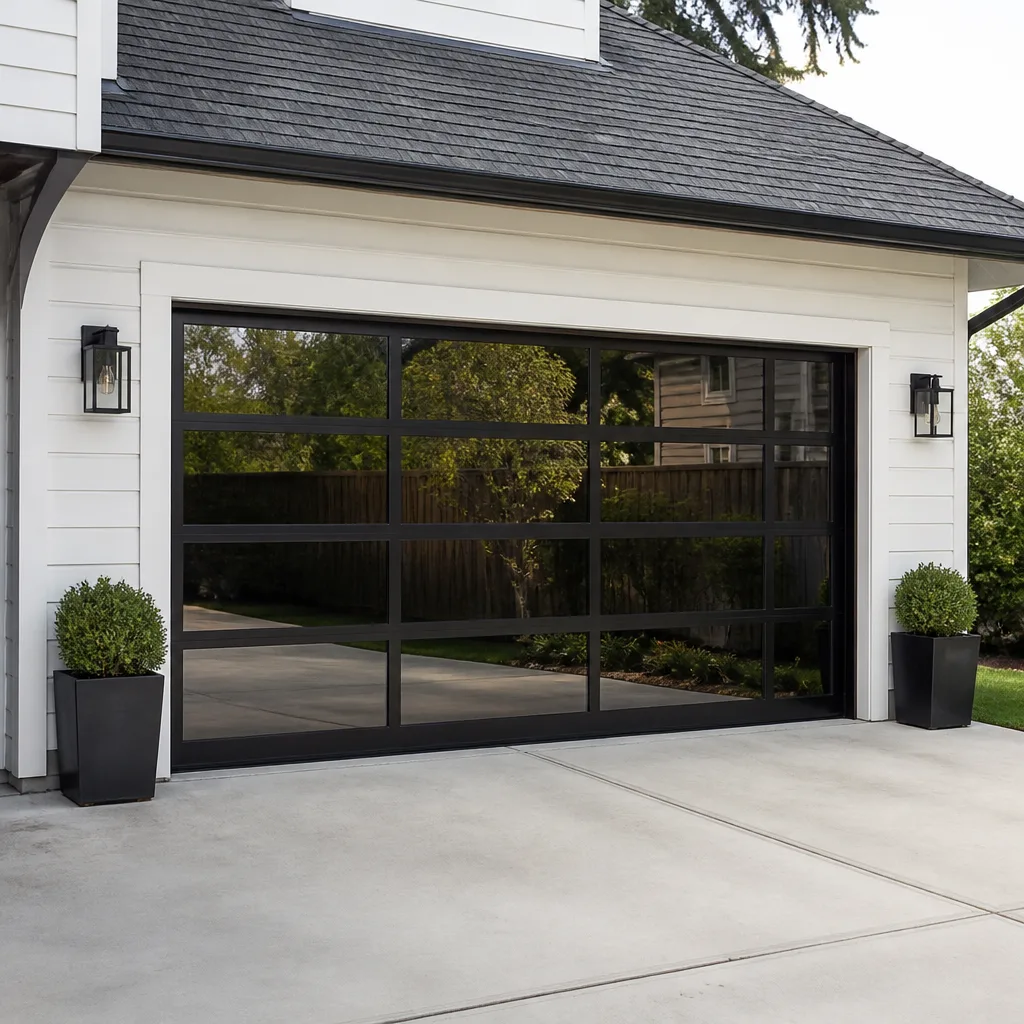 Full-view glass
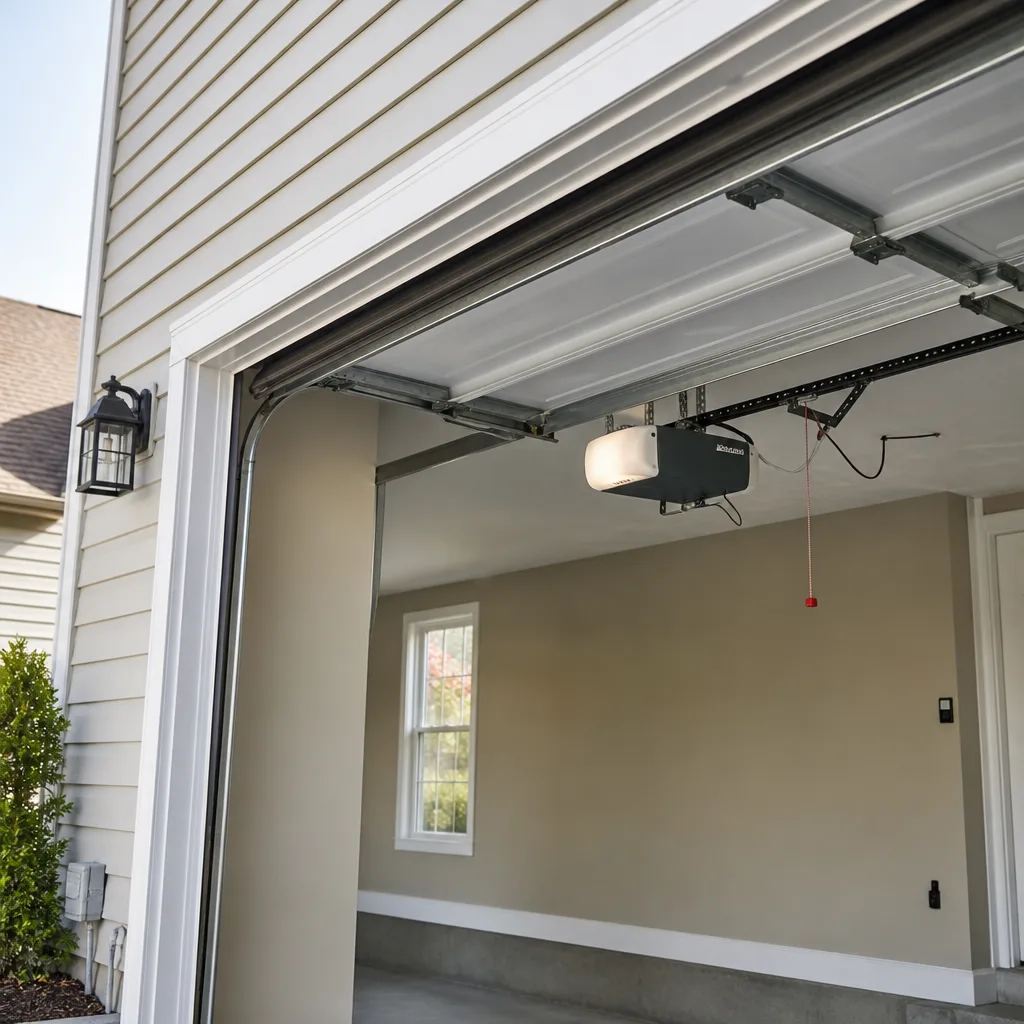 LiftMaster openers
 Chamberlain openers
Full 25-point door and opener safety check with every visit - springs, cables, rollers, tracks, and your LiftMaster or Chamberlain opener included
You get a price before we start. It does not change when the truck arrives.
Get your free estimateGarage Door Warning Signs: An Apple Valley Homeowner’s Reference Guide
We’ve taken thousands of calls in Apple Valley, and the most common sentence we hear before an emergency appointment isn’t “my door won’t open.” It’s “It was a little slow for a few weeks, but I figured that was normal.” A garage door that’s slow to respond isn’t a quirk. It’s a dying spring. Your door cycles hundreds of times a month, and the High Desert’s temperature swings push every component harder than most climates do. This guide covers the early-stage signals homeowners routinely dismiss, what each one means mechanically, and how to tell the difference between a genuine problem and a harmless seasonal quirk – though for a deeper look at year-round patterns, see our Seasonal Garage Door Care for Apple Valley: Year-Round Homeowner’s Guide. If you live in Apple Valley, your door will eventually show these signs. Knowing them now saves you a snapped spring at 7 a.m. on a workday.
Styles & brands we work with
- Raised-panel steel
- Carriage house
- Modern flush
- Full-view glass
- LiftMaster openers
- Chamberlain openers
Quick Answer
The most reliable early warning signs of a failing garage door in Apple Valley are a door that feels heavier than it did six months ago, a grinding or rattling sound that wasn’t there before, visible rust or powder on the torsion spring above the door, inconsistent gaps along the bottom seal, and small stress cracks in the steel panels. Any one of these means a component is wearing unevenly, and several indicate the springs are near end-of-life. Ignoring them turns routine repairs into emergency replacements.
Table of Contents
- “My Door Feels Heavy” – The Spring Test
- The Opener Noise Taxonomy: Grinding, Rattling, and Squealing
- Spring Corrosion in Dry Air: What It Actually Looks Like
- Bottom Seal Gaps: Weatherstripping vs. Structural Shift
- Panel Stress Cracks: High Desert Heat Cycles
- Opener Behavior That Isn’t Normal
- Common Mistakes to Avoid
- When to Call a Professional
- Frequently Asked Questions
- The Bottom Line
“My Door Feels Heavy” – The Spring Test
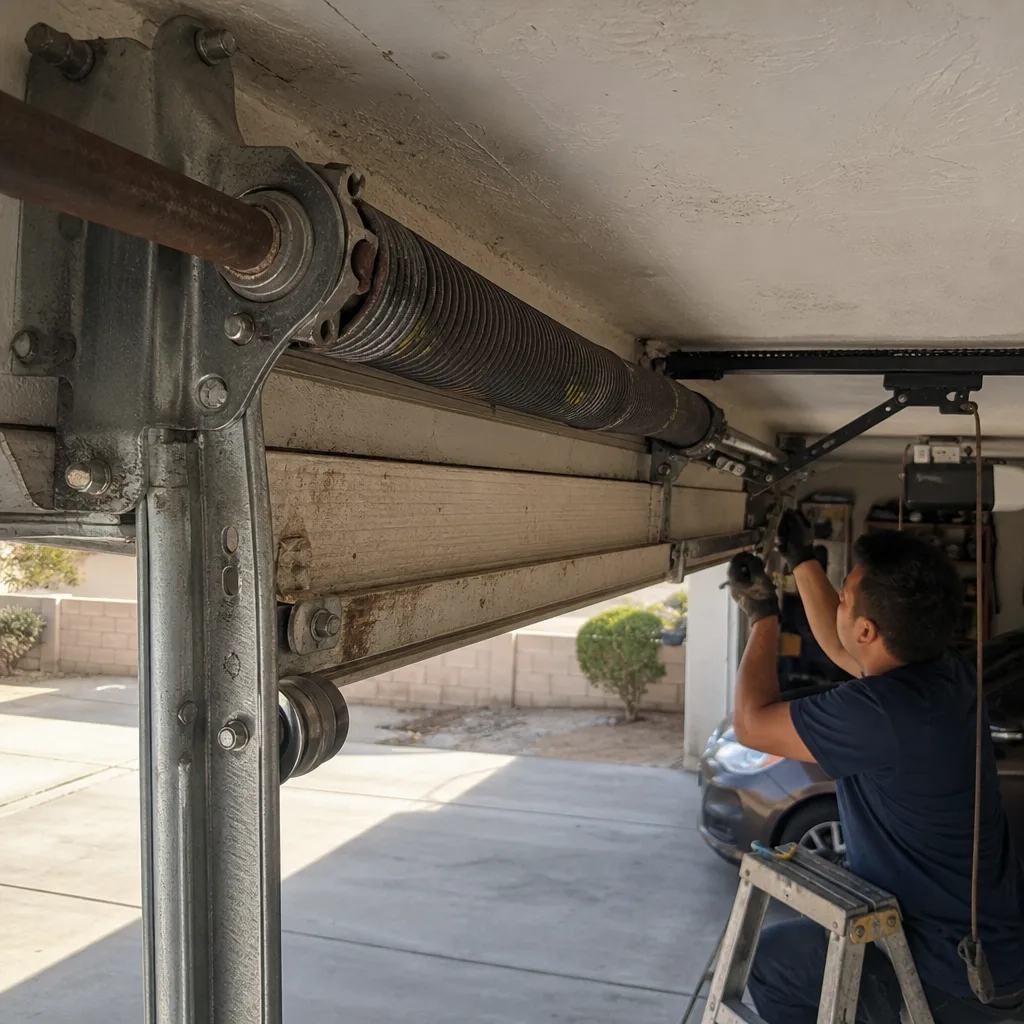
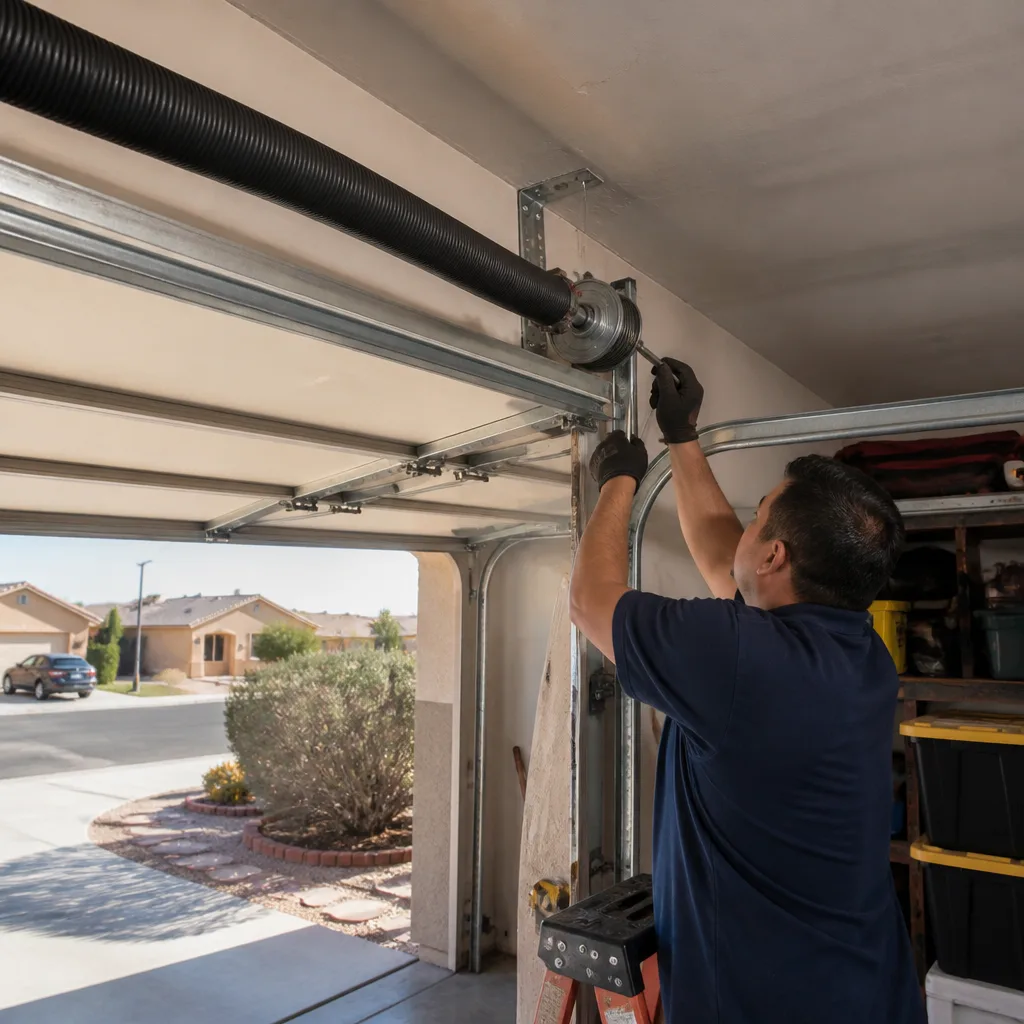
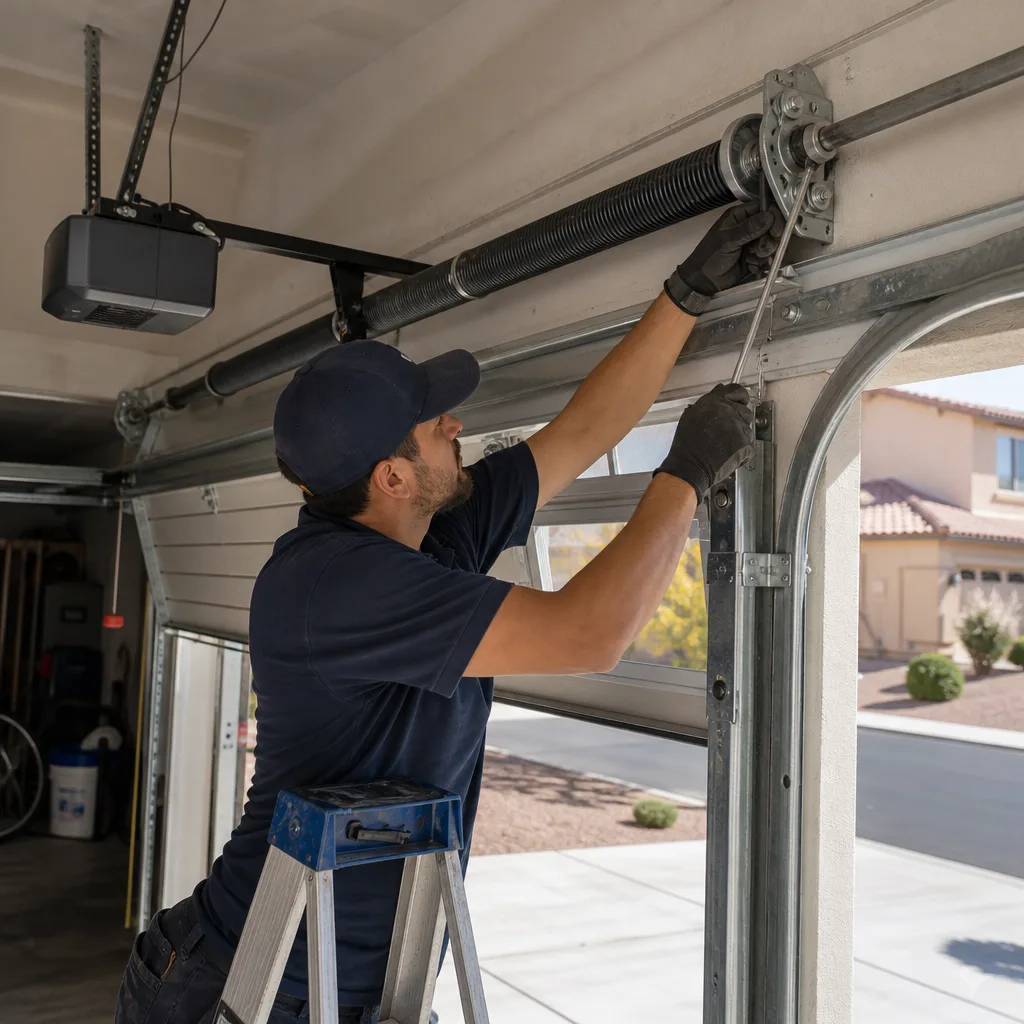
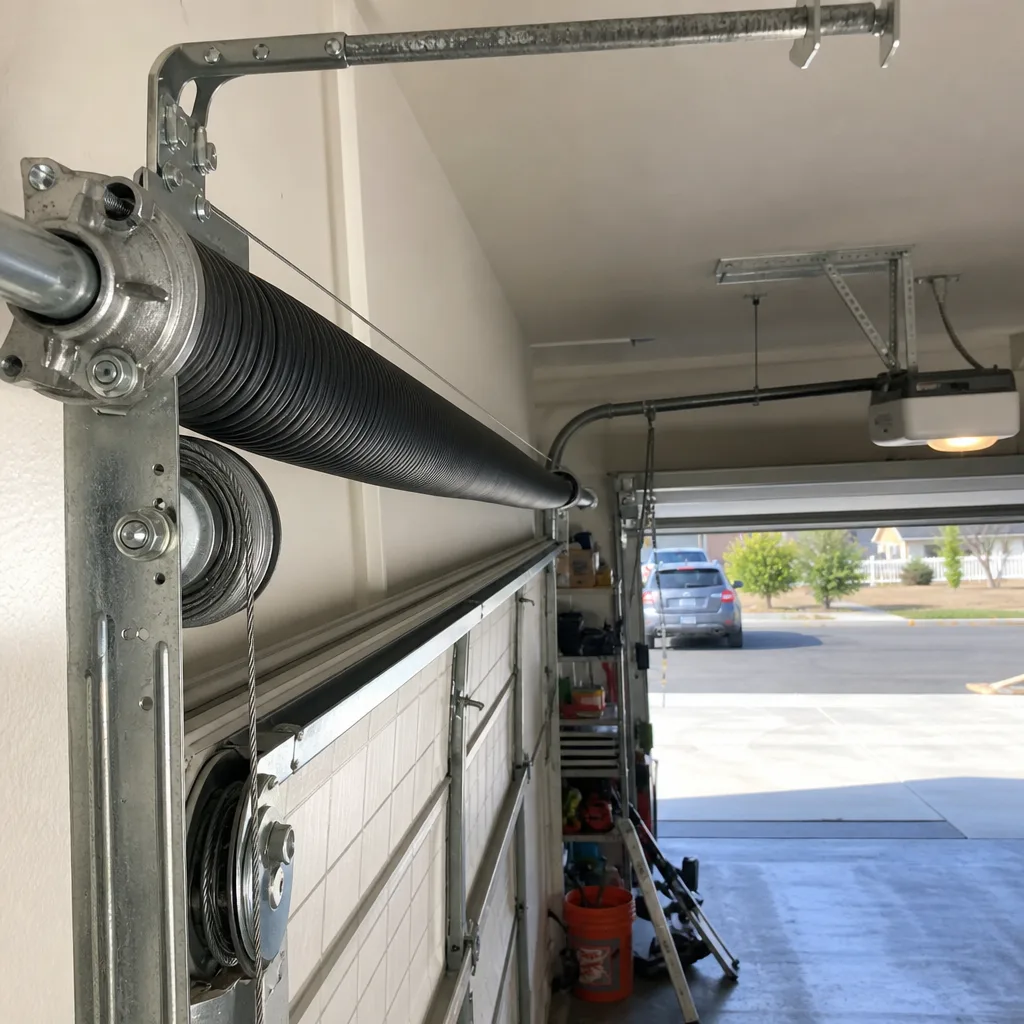
This is the warning sign we wish every Apple Valley homeowner recognized. A torsion spring system, the pair of coils mounted above the closed door, does the actual lifting. The opener motor is just a trigger; the springs carry the weight. When a spring loses tension through metal fatigue, the door’s real weight transfers to whatever is doing the lifting. You feel it as heaviness when you operate the door manually. The opener feels it as strain. Both are roads to failure.
Here’s the test to tell the difference between a genuine spring problem and a cold-morning false alarm. Metal contracts in cold overnight temperatures, which makes everything feel stiffer at 5 a.m. That’s normal, especially from November through February in the High Desert. The door should smooth out within a single cycle as the metal warms from use. A spring in decline doesn’t smooth out. It feels consistently heavy every single cycle, whether it’s 40 degrees or 75 degrees outside.
The manual test: pull the red emergency release cord while the door is closed, then lift the door by hand. A healthy door lifts to waist height with moderate effort and stays put, neither creeping up nor sagging down. A door with a failing spring needs genuine muscle to raise, and it won’t hold position without drifting. Try this once. If the door feels noticeably heavier than it did last season, that’s a spring reaching the end of its working life, not a misbehaving opener.
Springs have a finite cycle count, usually rated between 10,000 and 20,000 cycles depending on the spring wire and the installer’s choice at the time. For a door used four times a day, that’s about seven to fourteen years of service. Most Apple Valley homes hit that window on the original springs within the first decade. When one spring fails, the other is typically close behind. We always recommend replacing both together, a practice that keeps the door balanced and prevents a second service call six months down the road.
The Opener Noise Taxonomy: Grinding, Rattling, and Squealing
Noise is the most overlooked diagnostic tool on a garage door. Every Apple Valley driveway has its own acoustic signature, and homeowners get desensitized to it over time. But there is a precise vocabulary here, and each word points to a different failing component with a different urgency level. Here’s the breakdown as we’ve learned it in thousands of service calls:
- Grinding: A low, laboring sound with a gravel-like texture is almost always the opener motor unit itself. Plastic gears inside the opener, common on LiftMaster and Chamberlain residential models, wear flat over several years. When the teeth lose their sharp edges, the motor labors and the gears slip. This is a same-week repair item. The door will continue to operate until the gears strip completely, but then you’re hand-lifting a fully closed door with a grenaded gearbox.
- Rattling: A lighter, metallic chatter that moves with the door panels means loose hardware, hinge play, or rollers wearing out. In Apple Valley, where the dry air accelerates the brittleness of nylon roller bearings, a rattle often starts as a minor annoyance and progresses to a panel that shudders mid-travel. Loose hinges transfer load unevenly and can crack the panel steel around the attachment points. This is a schedule-soon item.
- Squealing: A high-pitched shriek, especially during opening and closing travel, usually indicates metal-on-metal contact between the rollers and the track, or between the spring coils themselves. When the protective coating wears off the spring wire, the coils rub and sing. A small amount of squeal on an older door is expected, but a pronounced, consistent shriek means the lubrication has failed and the components are wearing faster than they should. This is a diagnostic-visit item.
The key takeaway: grinding involves the opener motor and requires attention in days, rattling involves the structural hardware and can wait a week or two, and squealing is a lubrication and wear signal that tells you the door’s moving parts are consuming themselves. All three get louder and more expensive the longer they’re ignored.
Spring Corrosion in Dry Air: What It Actually Looks Like
People think of rust as a coastal problem, something for beach towns and rainy climates. In Apple Valley’s dry air, rust presents differently, and homeowners routinely mistake it for surface dust. The key difference is in the texture and the pattern.
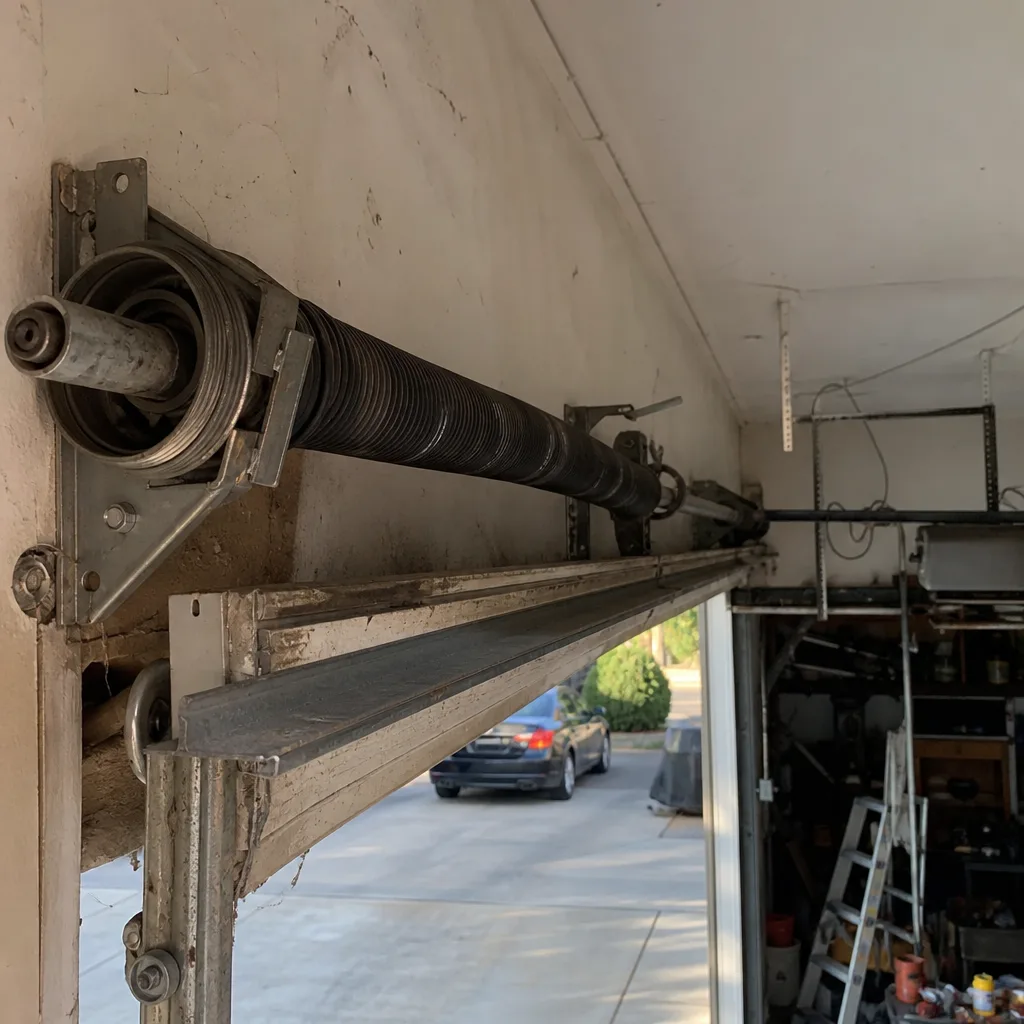
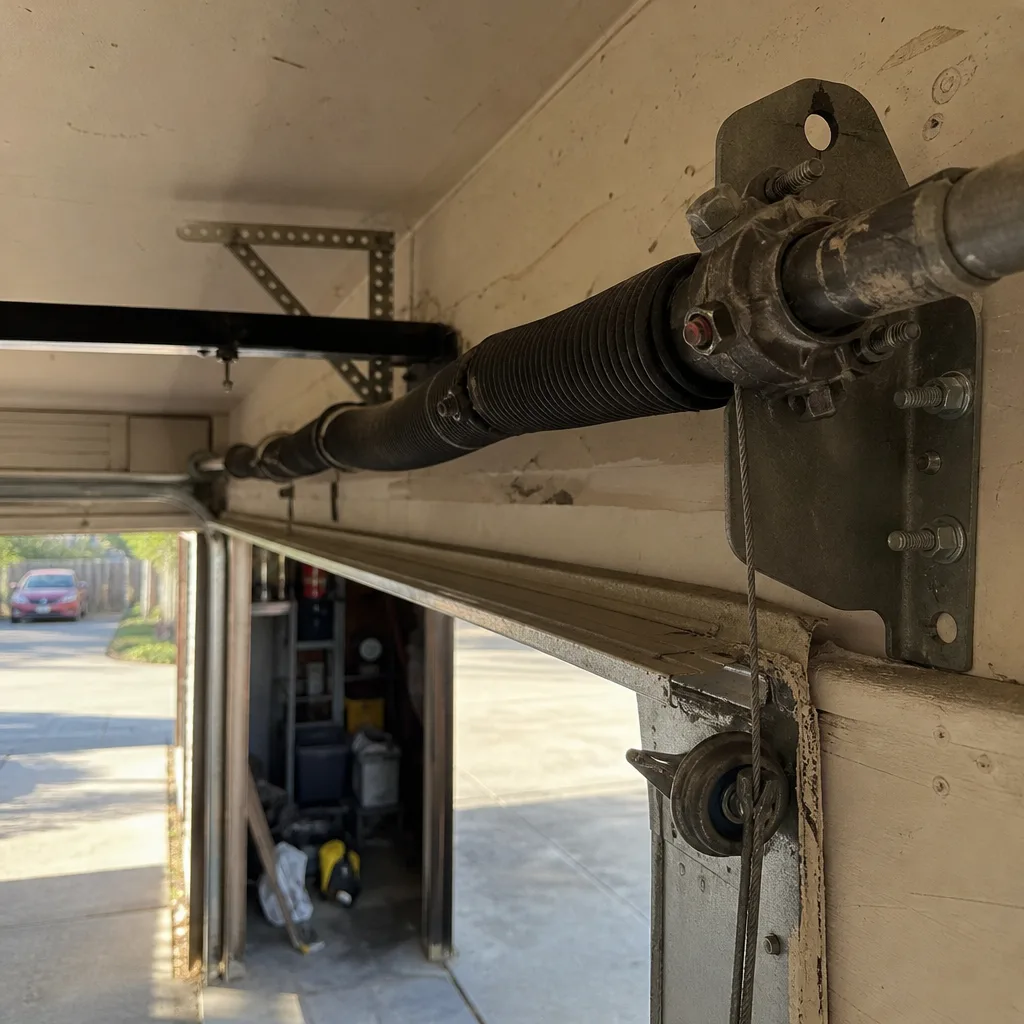
Surface dust on a torsion spring is uniform and wipes off with a finger. Rust does not wipe off. It appears as a reddish-brown or orange-brown flaking, often unevenly distributed, starting at the ends of the spring where stress concentrates. In dry climates, you’ll also see a fine, powdery orange haze that looks like someone dusted the spring with colored chalk. That powder is oxidation. The wire is thinning.
The reason this matters in the High Desert specifically is the temperature swing. Apple Valley regularly sees 30-degree differences between the day’s high and overnight low. Those swings cause micro-expansion and micro-contraction at the spring’s molecular level. A spring with intact coating absorbs that stress quietly for years. A spring with compromised coating is exposed to moisture in the air, however little, and the oxidation accelerates the fatigue process at precisely the stress points where the spring will eventually snap.
When we inspect a door in Apple Valley and see orange powder on the coils, we don’t wait for the snap. We recommend replacement during the same visit. The cost of a planned spring replacement is a fraction of the emergency equivalent, and you get to choose the timing. Don’t wait for a sound like a gunshot from the garage.
Bottom Seal Gaps: Weatherstripping vs. Structural Shift
Every Apple Valley homeowner knows the bottom seal. It’s the rubber strip along the base of the door that keeps dust, wind, and the occasional lizard out of the garage. When the seal shows a gap, most people assume it’s worn weatherstripping and replace the strip. Sometimes that’s correct. Often it isn’t.
Here’s the diagnostic question: is the gap consistent across the full width of the door, or does it vary from one side to the other? A weatherstripping failure produces a uniform gap. The rubber has compressed over years of door cycles, and the gap appears evenly along the entire base. Replace the strip, problem solved.
An inconsistent gap, tight on one end and wide on the other, is a structural alignment issue. The garage floor may have settled, common in Apple Valley where soil shifts with the extreme wet-dry cycle of desert clay. Or the door’s cable drums have slipped, leaving one side hanging lower than the other. Or the spring tension is uneven, pulling one side up harder. In any of those cases, a new weatherstrip won’t fix anything. You’ll spend money on a seal and watch the gap reappear within months because the door itself is crooked.
The fix for an inconsistent gap starts with a level check on the door itself. If the bottom section is bowing or the door is out of square, the solution is cable and spring adjustment, not weatherproofing. A technician who looks at the gap and orders a new seal without checking the door’s balance is treating a symptom. That’s the difference between a $40 strip replacement and the underlying tension correction that actually holds.
Panel Stress Cracks: High Desert Heat Cycles
Steel garage door panels are not immune to the High Desert sun. Apple Valley summers push surface temperatures on a south-facing door past 150 degrees. At night, that same panel drops to 60. Over enough years, that repeated thermal cycle does what thermal cycling always does: it creates stress at weak points.
The weak points are the flanges, the folded edges where the panel meets the next section, and the areas around hinge attachment holes. Small hairline cracks in the paint are cosmetic and common. Stress cracks in the steel itself look different. They’re slightly wider, often rusty or starting to rust at the edge, and they radiate out from a hinge or a corner. Hold your hand near one while the door operates and you’ll see the crack widen microscopically with each section flex.
A steel panel with a true stress crack is compromised. It absorbs less force from the door’s daily operation, and that load transfers to the neighboring sections. What starts as a hairline becomes a tear, and a torn panel eventually buckles, jamming the door in its tracks or dropping a section mid-travel. In Apple Valley, where doors see more heat stress than almost any climate in California, we see panel fatigue on south-facing doors within fifteen years of installation.
If you see cracks forming in a steel panel, the honest assessment is usually replacement of that section. Repairs to cracked steel panels, welding or patching, are short-term patches. The metal’s fatigue isn’t reversible. For doors where sections are no longer readily available, a new door may be the only durable fix. On a Clopay or Amarr door still in production, a section replacement is straightforward. On a discontinued Wayne Dalton or Craftsman line, the math tilts toward replacement, which is where Choosing the Right Garage Door Brand: A Buyer’s Guide for Apple Valley can help you plan ahead.
Opener Behavior That Isn’t Normal
Your garage door opener is the most used appliance in the house that nobody thinks about. It cycles more times per day than your dishwasher and has a motor, a logic board, and a set of moving parts all operating in a dust-prone environment. When it starts behaving oddly, Apple Valley homeowners often assume the door itself is the problem. Here are the opener behaviors that should send you looking for a diagnosis:
Reversing mid-cycle. The door starts to close, hits a spot on the track, and reverses back up. This is the opener’s safety mechanism doing its job. In most cases, the problem is physical resistance: a track obstruction, a roller binding, or a spring that’s losing power and making the door heavier than the opener expects. The opener isn’t misbehaving; it’s reacting to a mechanical problem.
Short opening. The door opens partway and stops. In an older Genie or LiftMaster, this often traces to the travel limit settings, which drift over time as the logic board ages. In a newer Chamberlain with a DC motor, the issue is more likely a force-sensitivity setting that’s out of calibration. Either way, the opener thinks the door has traveled farther than it has.
Intermittent failure. The door opens fine three times, then won’t respond on the fourth. This is the classic fingerprint of a failing logic board or a worn capacitor, both caused or worsened by heat exposure in an uninsulated garage. Apple Valley garages regularly exceed 120 degrees in summer, and electronics age fast in that environment. Intermittent opener faults are exactly the kind of problem we diagnose in the same visit as the mechanical door check, because the two systems share a life. A door that strains against a weak spring stresses the opener, and a weakening opener sends inconsistent force through the door. Treating them separately misses the connection.
If your opener stumbles, don’t assume it’s the door. If the door feels heavy, don’t assume it’s the opener. The two are a system, and a proper diagnosis reads both sides. For more on the opener side specifically, see our Garage Door Opener Repair in Apple Valley page.
Common Mistakes to Avoid
- Lubricating a failing spring to quiet it. Squealing springs are past the point where lubricant helps. Oil quiets the symptom and masks the wear, giving you a false sense of resolution while the spring continues to fatigue.
- Replacing the weatherstrip without checking door level. We covered this above: an uneven gap is an alignment issue. New rubber on a crooked door is money spent on nothing.
- Adjusting the opener force settings to compensate for a weak spring. This is the single most dangerous homeowner fix. Cranking the opener’s force to push a heavy door is a bandage that puts more load on both the spring and the opener motor, accelerating the inevitable failure and making it more violent when it comes.
- Ignoring minor panel cracks because they’re small. Stress cracks never shrink. They only grow. A visible crack today is a buckled panel in six months.
- Waiting until the spring snaps to schedule service. A planned spring replacement on your schedule is half the cost of an emergency repair, and you get to keep using the door during the wait. A snapped spring means no car, no driveway access, and a bill that reflects the urgency.
- Assuming all garage door companies work on all brands. Many single-trade shops specialize in one or two manufacturers. When choosing a technician, ask directly whether they handle your door’s brand. We work on Clopay, Amarr, Wayne Dalton, and Craftsman doors alongside the openers that drive them, and we recommend parts based on your door’s actual configuration, not on a vendor relationship.
When to Call a Professional
Call the day you notice a consistent change in your door’s behavior. The door suddenly feels heavy. The opener makes a new grinding sound. You see orange powder on the spring. The bottom gap is uneven. A panel shows a stress crack. Any one of these is worth a diagnostic visit, and all of them are cheaper to fix before failure than after. If the spring has already snapped, don’t operate the door manually and don’t try to reset the cables yourself. The torsion system holds enormous energy, and the cables are under tension even when the door is down. Brightwater Garage Door Repair offers free estimates in Apple Valley and we’re happy to look at any door, any brand, any time before you spend a dollar. Call (855) 473-2508 and we’ll tell you honestly whether repair or replacement makes sense.
Frequently Asked Questions
The five signs we see most often in Apple Valley are a door that feels consistently heavy, opener noise that changes character, rust or orange powder on the torsion springs, uneven gaps under the door, and hairline stress cracks in the panels. Each points to a different component, and all of them are cheaper to address early than to repair after failure.
Most standard torsion springs in the Apple Valley market are rated for 10,000 cycles, which works out to about seven to ten years for a typical homeowner who opens and closes the door four times a day. Dry air and extreme temperature swings can shorten that life. If your door is older than seven years and you haven’t replaced the springs, you’re in the window where a failure becomes more likely than not.
We don’t recommend it. Torsion springs store enough energy to cause severe injury if released improperly, and the winding process requires tools and knowledge most homeowners don’t have. A spring under tension isn’t a DIY project, it’s an accident waiting for a single wrong move. A professional replacement is measured in hours and costs less than most people expect when done before the spring breaks.
That’s thermal contraction. Metal stiffens in cold temperatures, and overnight Apple Valley lows can drop 30 degrees below the daytime high. The door feels stiff for the first cycle or two until the moving parts warm from use. If the heaviness persists through multiple cycles and across different times of day, that’s a spring losing tension, not a temperature effect.
It usually means the opener’s travel limits or force settings have drifted out of calibration, or the door is encountering enough resistance that the opener’s safety reversal triggers early. The fix may be a limit adjustment, but it’s worth having a technician check the door’s balance at the same time, because a failing spring is often the hidden cause of opener behavior that looks like an electrical problem.
The cost depends on which component is involved. Spring replacement on a typical two-car door in Apple Valley runs in the low hundreds of dollars for a pair of standard torsion springs. Opener gear replacement is less. A panel replacement is more, and a full door replacement is the highest-ticket item. The range is wide, but the principle holds: catching a warning sign early is always cheaper than responding to a failure. Call (855) 473-2508 for an exact quote. Estimates are free, and the price you’re quoted is the price you’ll pay, agreed before any work starts.
The Bottom Line
Garage doors don’t fail all at once. They fail gradually, and the warning signs are there for anyone who knows what to look for. A heavy-feeling door is a spring losing tension. A grinding sound is a gear stripping. Orange powder on the spring is rust, not dust. An uneven bottom gap is an alignment issue, not a weatherstrip problem. A stress crack in a steel panel is the first chapter of a longer failure. Every one of these signals is cheaper to address now than to ignore. And for Apple Valley homeowners, whose doors live in one of the most demanding climates in California, the margin for ignoring these signs is thinner than most. If any of this sounds like your door, Brightwater Garage Door Repair home has the full picture on how we diagnose and fix doors across the High Desert. For the repair side specifically, see our Garage Door Repair in Apple Valley guide. And if it’s the opener acting up rather than the door, our Garage Door Opener Repair in Apple Valley page covers that side too. If you’re weighing repair against new, the Garage Door Installation in Apple Valley page walks through the decision honestly.
Written by the team at Brightwater Garage Door Repair, serving Apple Valley since 2018. For more guides & resources, visit our blog.
See the difference
 Before
 After
 Before
 After
 Before
 After